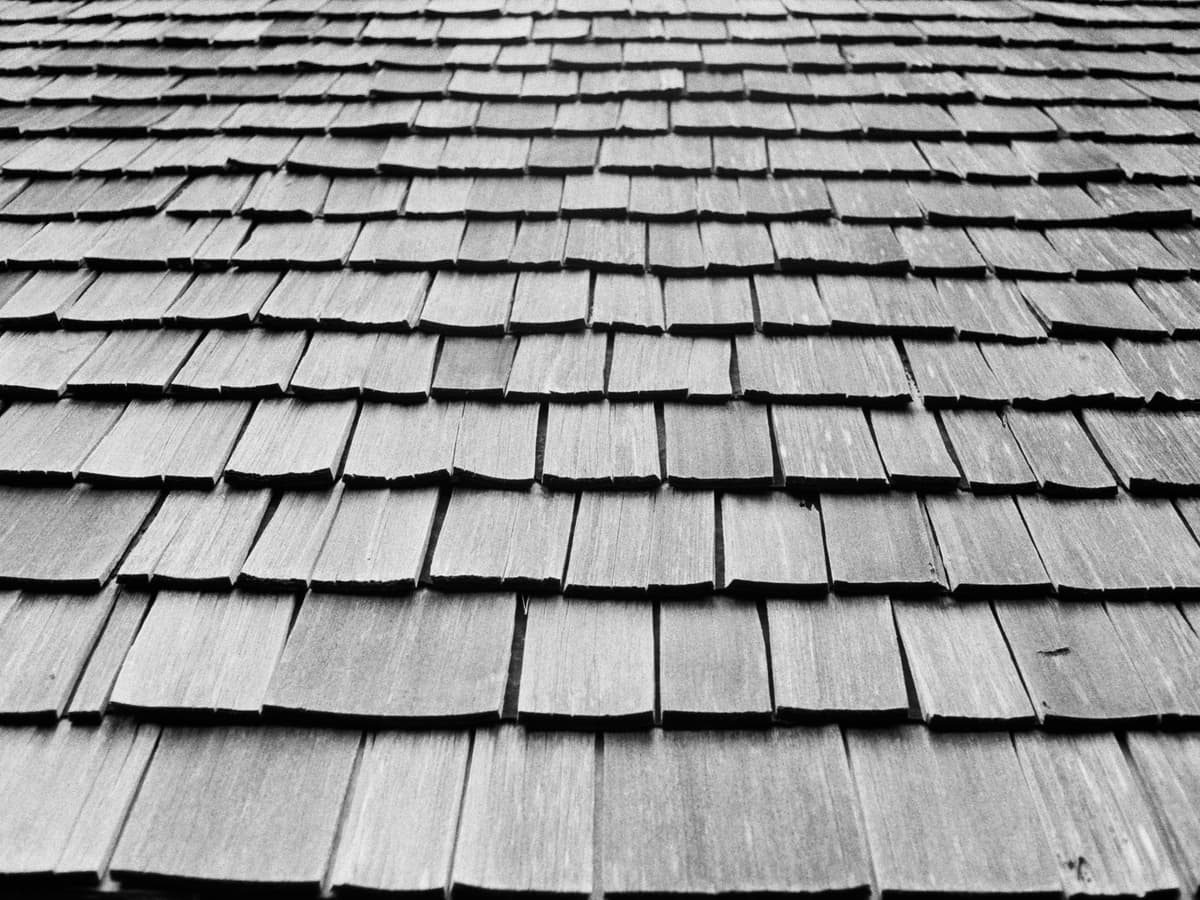
A worn cedar shake roof in Portland has three ways forward. Repair it if the damage is isolated and the deck underneath is sound. Re-roof in new shakes, built to the rules Oregon’s code sets for wood. Or convert to composition shingles or metal, which nearly always means a new solid deck over the old spaced boards. Fire ratings, permits and historic-district rules can narrow the choice, so check those before you price anything.
Shakes or shingles: which is on your roof?
Both are usually western redcedar, but they are made, graded and installed differently. The Cedar Shake and Shingle Bureau, the trade association that runs the Certi-label grading program, puts it this way: shingles are precision-sawn on both faces, while shakes are split from the block along the grain. Oregon State University Extension’s guide to wood roofs adds that many shakes made today have at least one smooth face, which makes them easier to lay.
| Product | How it is made | Grades the Bureau uses |
|---|---|---|
| Handsplit and resawn shake (Certi-Split) | Split face, sawn back; medium or heavy thickness | Premium (all edge grain), then No. 1 (up to 20 percent flat grain per bundle) |
| Tapersawn shake (Certi-Sawn) | Sawn on both faces, but thicker at the butt than a shingle | Premium, No. 1 and No. 2 |
| Cedar shingle (Certigrade) | Sawn on both faces, thinner and uniform; 16, 18 or 24 inches long | No. 1 Blue Label, No. 2 Red Label, No. 3 Black Label |
A No. 4 shingle also exists, but the Bureau calls it a utility grade for the hidden under-course of walls, not a roofing material.
On a roof that is already up there is no bundle label to read, but the faces tell the story: a split face is rough and follows the grain, a sawn face is smooth. It matters beyond looks. The USDA Forest Products Laboratory warns that felt laid between shingle courses keeps them from drying and rots them, while Oregon’s code requires felt strips between shake courses, and Oregon City’s historic policy treats the two differently (see the permit section).
What wears out a cedar roof in Portland?
Cedar heartwood holds natural compounds that resist decay, but OSU’s wood scientists list the slow ways any wood roof gives out:
- Weathering. Sun, rain and wind turn new cedar light grey within a year and slowly wear the soft part of each growth ring away, leaving a washboard surface.
- Wetting and drying. Wood swells when wet and shrinks as it dries; years of that cycle open splits and make pieces cup or warp.
- Decay under the overlap. Decay fungi do their work where each shake covers the one below, where moisture lingers.
- Shade and debris. Overhanging trees shade the roof, so it dries more slowly between storms, and drop needles and leaves that hold water. The Bureau’s maintenance advice says the same of fir needles packed into the gaps between shakes: cedar needs to breathe. For roofs under heavy canopy, see the Lake Oswego page.
- Moss. OSU Extension’s note on roof moss says moss does not attack the wood directly; it traps soil and debris, so the roof stays wet longer, which invites fungi and shortens its life. Portland Roof Pros does not take cleaning or moss treatment requests, but a roof inspection will show what the growth has already done.
- Air under the deck. The Bureau names poor ventilation among the most common contributors to early failure, since the back of each shake has to dry too; see our roof ventilation guide.
Climate sets the pace: OSU notes that the same wood roof lasts much longer in Oregon’s dry high desert than in the cool, wet west of the state. The Bureau puts the average life of a cedar roof at roughly 30 to 40 years, and the Forest Products Laboratory says a properly installed and maintained one should pass 30; our guide to how long a roof lasts in Portland compares other materials. The Laboratory adds that old shakes turn brittle and crack underfoot, so leave the close look to a roofer.
Repair, re-shake or convert?
The Bureau’s guidance is practical. A repair still makes sense when the damage covers a small part of the roof, the shakes around it are sound with no widespread cracking or cupping, and the deck shows no rot. Replacement is the answer when curling, cupping or splitting runs across several roof planes, the shakes have weathered noticeably thinner, leaks keep coming back after spot repairs, or rot has reached the flashings, ridges or eaves. Badly curled shakes, it adds, should be replaced rather than nailed flat.
| Repair | New cedar | Composition shingles | Metal | |
|---|---|---|---|---|
| Fits when | Damage is isolated and the rest is sound | You want to keep a wood roof and no fire or historic rule stands in the way | You want the least expensive common roofing | You want a covering the code treats as Class A |
| The deck | Stays as it is | Spaced boards or solid sheathing, repaired as needed | New solid sheathing over the whole roof | Solid sheathing, or over the shakes where the recover rules allow |
| Rules to check | Grade and fasteners that match the code for new work | Oregon’s wood shake rules, fire class near lot lines | Solid deck, ventilation where sheathing is replaced | Recover limits, a cover layer over the shakes, historic districts |
Re-roofing in new cedar: what Oregon’s code asks for
A like-for-like replacement follows the wood shake section of the Oregon Residential Specialty Code (R905.8; wood shingles are R905.7). The points to check on a bid:
- The deck. Solid sheathing, or spaced boards no smaller than 1 by 4 inches, set on centers equal to the weather exposure so each course is nailed into a board (R905.8.1).
- The slope. At least 3 in 12 (R905.8.2). The Bureau’s product sheets list its shakes for roofs of 4 in 12 and steeper.
- Felt between courses. Each course is interlaid with 18-inch strips of felt, set so none shows to the weather (R905.8.7).
- Graded, labeled material. At least No. 1 grade under the Bureau’s rules (tapersawn shakes may be No. 2), with a grading label on every bundle (R905.8.5, R905.8.9).
- The right fasteners. Two per shake, in Type 304 or 316 stainless steel or hot-dipped galvanized steel with an ASTM A153 Class D coating, reaching at least 3/4 inch into the sheathing or right through thinner sheathing; Type 316 stainless for treated shakes (R905.8.6).
- New ridge caps. The Bureau says old hip and ridge caps come off rather than being covered.
In this climate, the Forest Products Laboratory says shakes laid straight onto solid sheathing in humid regions need preservative treatment, and it favors a rain-screen or nailing strips that let air reach their backs. The Bureau notes that plywood is the only solid sheathing its products were tested on. Treated shakes come as Certi-Last (preservative) or Certi-Guard (fire retardant), and the Bureau says the two treatments are not currently available together.
Converting a shake roof to composition shingles
The deck is what makes this a bigger job than a shingle-to-shingle reroof. Oregon’s code says asphalt shingles shall be fastened to solidly sheathed decks (R905.2.1), and spaced boards are not a solid deck. Malarkey, the Portland-based shingle maker, requires the same in its installation instructions, with any boards set tight to each other, and its technical bulletin on board decks recommends that old board decks be overlaid or replaced with code-compliant sheathing, warning that gaps of 1/4 inch or more, left uncorrected, may void the shingle warranty.
Can the new shingles go over the shakes instead? The code allows a recover over an existing wood shake roof for metal panels, metal shingles and clay or concrete tile (R908.3.1). Composition shingles are not on that list, and Malarkey’s re-roofing directions cover going over old asphalt shingles only. So in practice the shakes come off, the bad boards are replaced, and plywood or OSB goes over the whole roof, on top of the boards or in their place, before underlayment, new flashing and the shingles.
Put the vents on the bid as their own line. Shakes on spaced boards have air moving behind them; a new solid deck closes that path, and Oregon has a rule for this moment. Where sheathing is replaced before a new roof covering goes on, ventilation in the affected areas must meet the attic ventilation section of the code (R908.1.1, an Oregon amendment). Ask how much intake and exhaust the roofer plans and where; the ventilation guide shows how to check the numbers, and the roof replacement page lists what else the bid should spell out.
Switching from shakes to metal
Metal panels and metal shingles are among the coverings the code lets you lay over existing shakes (R908.3.1). Where that would leave a combustible hidden space, the whole old surface is first covered with gypsum board, mineral fiber, glass fiber or another approved material (R908.4), and no recover is allowed over two or more existing layers or a roof too wet or deteriorated to serve as a base (R908.3.1.1). Oregon’s version of the code treats metal sheets and shingles as Class A roof assemblies (R902.1). The metal roofing page compares panel types and the metal shingles made to look like shakes.
Fire ratings, lot lines and Portland’s Wildfire Zones
Roof coverings are fire-tested and rated Class A, B or C under ASTM E108 or UL 790. Oregon’s code requires a rated roof where a jurisdiction designates it by law, and wherever the edge of the roof is less than 3 feet from a lot line (R902.1). On a close-set older lot, measure that distance before ordering shakes.
For wood, the rating comes from fire-retardant treatment, pressure-impregnated by the full-cell vacuum-pressure process and labeled with its classification (R902.2). The Bureau’s Certi-Guard shakes carry a red label for Class B and a blue label for Class C; a Class A wood roof is a tested assembly built around treated shakes. Spray-on products are another matter: the Bureau does not endorse topical fire treatments, and the Forest Products Laboratory says no inspection agency guarantees them because rain can wash them out.
Portland mapped its Wildfire Hazard Zones under City Code chapter 24.51 “so that roof materials may be limited”, pointing houses in the zones to the state codes for the requirements. The City’s permit page still lists a reroof in a Wildfire Zone as permit work, and its wildfire guide says plainly that a treated wood shake roof gives the least protection. The state’s wildfire standards (R327) apply only to new buildings where a city or county has adopted them, and the Building Codes Division’s list of adopters (Ashland, Bend, Deschutes County, Grants Pass, Sisters) has no Portland-area name (checked October 7, 2026). Near one of Portland’s zones, ask Portland Permitting & Development before choosing shakes.
Permits and historic districts
The state rule changed this month. Chapter 1 of the 2026 Oregon Residential Specialty Code took effect on October 1, 2026 with no phase-in, and its permit exemption now covers reroofing, including replacement of damaged sheathing, where the increased dead load is 4 pounds per square foot or less (R105.2). Permits are still required for townhouses and attached stacked two-family dwellings, building-integrated solar roofing, and houses whose original construction had to meet a locally adopted R327. A conversion changes the weight on the roof, so ask the roofer whether the new assembly stays inside that limit.
Not every city page has caught up with the new state wording:
- Portland. The City’s residential permit guidance says a reroof with material of similar weight needs no building permit, even with some or all of the sheathing replaced, and lists Wildfire Zones, townhouses and building-integrated solar as exceptions.
- Gresham and Lake Oswego. Both list applying roofing when all of the old roofing is removed and new sheathing is installed as permit work, which is what a conversion with a new deck involves.
- Clark County, Washington. The County requires a re-roofing permit for every building, and possibly a separate one where sheathing is replaced. Inside Vancouver city limits the City’s own rule applies, as the permit guide below explains.
Oregon City has its own rule for historic houses. The Historic Review Board’s roofing policy allows wood shingles and 3-tab or architectural composition shingles, while shake shingles, like metal, need the Board’s approval. It covers locally designated houses in the McLoughlin district, every structure in Canemah and landmarks elsewhere in the city, so a sawn cedar shingle can be the simpler choice there. The Oregon City page has the detail, and our roof permit guide compares the cities.
What does a cedar shake roof cost?
The cost page notes that wood shake costs more per square than composition and that new decking adds to a bid, but it has no shake row yet, and the Bureau says antitrust law keeps it out of any discussion of prices.
So ask one roofer to price both routes on the same visit: new cedar on the existing deck, and composition shingles with a new deck, with the sheet count and the ventilation work as separate lines. A free roof inspection is that visit, and the written quote that follows is the only price that fits your roof. Before you sign, check the license on the Construction Contractors Board’s search in Oregon, or the L&I registration in Washington.
This page is general information, not professional advice about your specific situation. Have it assessed by a qualified professional before making decisions. Last reviewed October 7, 2026.