
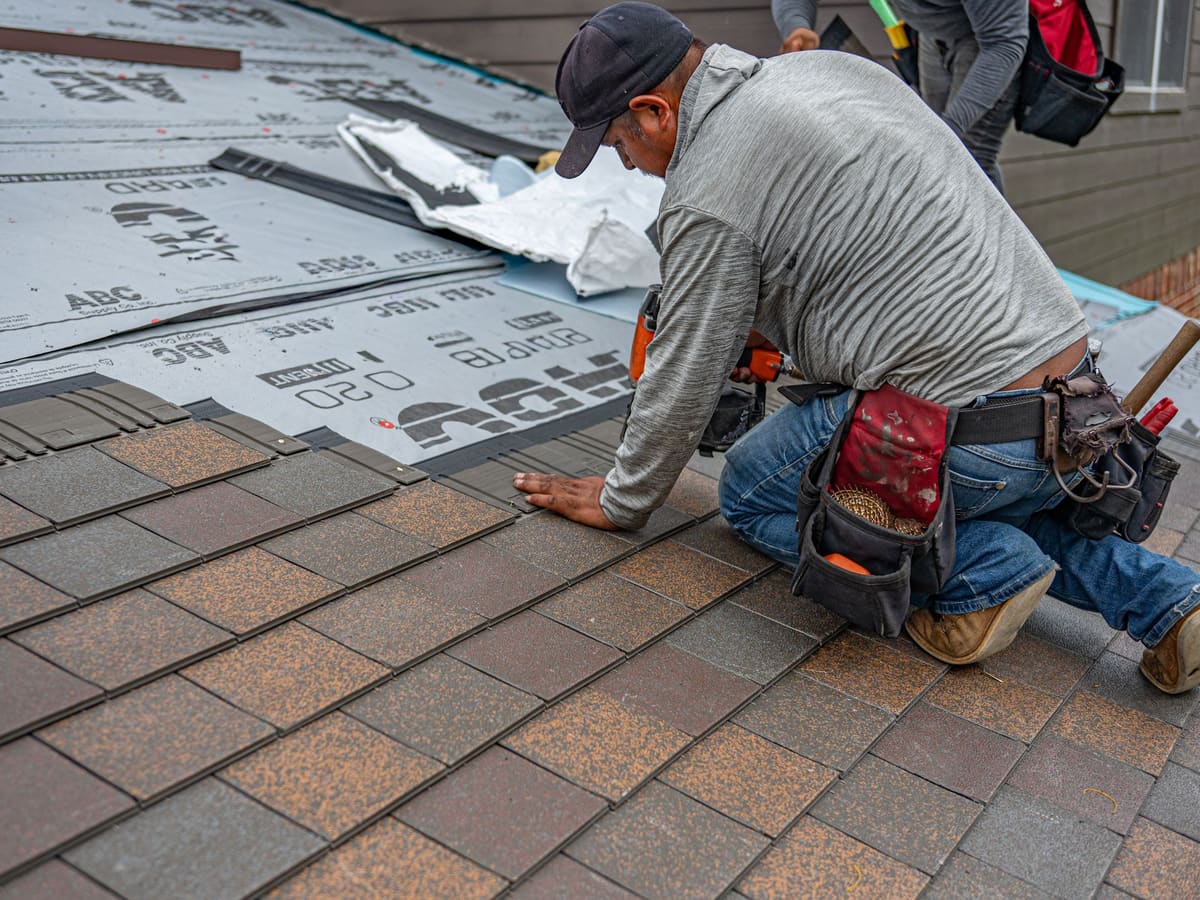
For a full replacement, Portland’s best months are June through September. NOAA’s 1991-2020 normals for Portland International Airport show fewer than four rain days in July and in August, against 18 to 19 a month from November through January. A wet-season replacement is possible, but rain and cold make it slower and harder to get right.
This guide is about planning a full replacement. A roof that is leaking now should not wait for summer: the roof repair page covers what can be fixed or covered in the wet season, and the roof leak guide covers what to do inside the house today.
Portland’s roofing weather, month by month
The chart counts the days in an average month with at least 0.01 inch of precipitation. It comes from the 1991-2020 monthly normals for Portland International Airport (station USW00024229), the official 30-year averages published by NOAA’s National Centers for Environmental Information.
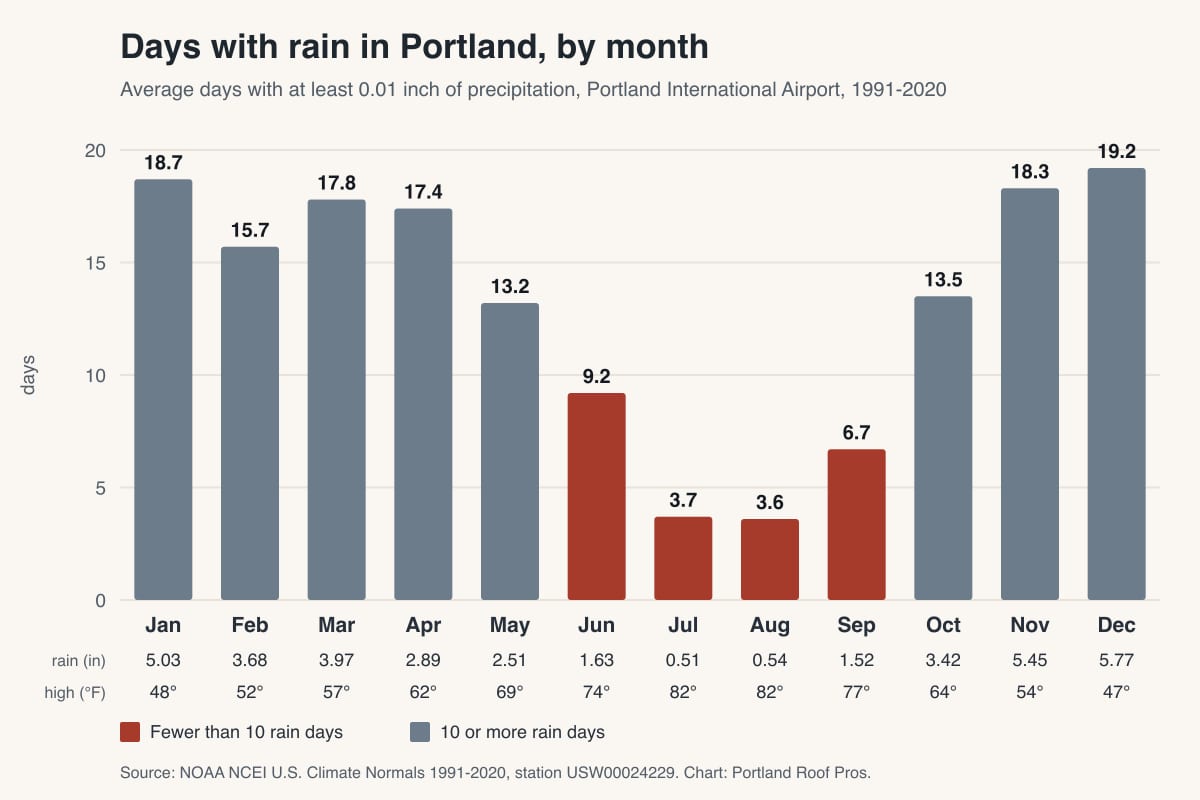
Average days with measurable rain at Portland International Airport, 1991-2020. Data: NOAA NCEI climate normals; chart by Portland Roof Pros.
| Month | Days with rain | Rain (inches) | Normal high | Normal low |
|---|---|---|---|---|
| January | 18.7 | 5.03 | 47.5 °F | 36.2 °F |
| February | 15.7 | 3.68 | 51.5 °F | 36.8 °F |
| March | 17.8 | 3.97 | 56.8 °F | 39.7 °F |
| April | 17.4 | 2.89 | 62.0 °F | 43.7 °F |
| May | 13.2 | 2.51 | 69.3 °F | 49.4 °F |
| June | 9.2 | 1.63 | 74.3 °F | 54.1 °F |
| July | 3.7 | 0.51 | 81.9 °F | 58.5 °F |
| August | 3.6 | 0.54 | 82.3 °F | 58.9 °F |
| September | 6.7 | 1.52 | 76.7 °F | 54.1 °F |
| October | 13.5 | 3.42 | 64.4 °F | 46.7 °F |
| November | 18.3 | 5.45 | 53.5 °F | 40.6 °F |
| December | 19.2 | 5.77 | 46.9 °F | 36.2 °F |
Three things stand out for anyone planning a tear-off:
- July and August are the driest months by a wide margin, with under four rain days and about half an inch of rain each. June and September are the shoulders, with 9.2 and 6.7 rain days.
- The wet season is long. From November through January a month averages 18 to 19 days with rain, and March and April are not far behind. The year adds up to 36.92 inches of precipitation on about 157 days.
- Winter nights are cold enough to matter. The normal low in December and January is 36.2 °F. That is below 40 °F, the point where Portland-based shingle maker Malarkey’s cold-weather guidance begins, as the winter section below explains.
The airport is one weather station, and a given year can be wetter or drier than its 30-year average, so treat the table as a guide to the seasons rather than a forecast for your street.
Why the dry months suit a full replacement
A replacement is the one roofing job that leaves the house open. Oregon’s residential code defines it as removing the existing roof coverings down to the roof deck (R908.3 in the 2023 Oregon Residential Specialty Code), so for part of each day the only thing between the weather and the attic is bare wood. Three things make that easier in July than in December.
A dry deck. Shingle makers write it into their instructions. Owens Corning’s installation instructions for its Oakridge shingles (July 2026) tell the installer to prevent the wood deck from getting wet before, during and after installation. Fewer rain days means fewer days when that is a fight.
Shingles that seal. Asphalt shingles are held down by nails and by a strip of sealant that bonds each course to the one below. Malarkey’s laminate shingle instructions describe that strip as a thermal sealant activated by the sun’s heat after the shingle is on the roof. Warm, sunny weeks seal a new roof quickly.
Room to fix the deck. Soft or rotted sheathing only shows once the old roofing is off, and replacing it means more hours with the roof open. The roof decking guide explains what gets replaced and how a bid should list it.
Can you replace a roof in the rain?
Not the part that matters. Some work can go on between showers, but shingles do not go down on a wet deck. Roofr, a roofing-software company, puts it bluntly in its guide to roofing job timelines: if sheathing gets wet, shingles cannot be laid until it is completely dry. In a Portland winter, a dry stretch long enough to tear off, dry in and shingle a whole slope can be hard to find.
So the question for a wet-season job is how much roof will be open at once. Before work starts, ask each roofer how much they plan to strip in a day, what goes over an open section overnight, and what happens to the schedule if rain is forecast.
What happens if it rains during a roof replacement?
It depends on how far the job has got. Rain on finished underlayment is mostly what underlayment is for: it sheds water while the shingles go on. Malarkey’s data sheet for its Secure Start Lite synthetic underlayment says it may be left exposed for up to 90 days, but is only part of a finished roofing system and not the primary roofing surface. It is a short-term cover, not a roof.
Rain on bare deck is the problem. Wood that has been soaked has to dry before it is covered, and wood panels expand as they take on moisture: APA, the engineered wood association, publishes guidance on the buckling that causes. If a storm catches an open section, ask the roofer to check those panels before they disappear under the new roof. Wet underlayment is also slippery: Malarkey warns installers that underlayments can be slippery when wet or covered with frost.
How long after rain can you shingle a roof?
There is no set number of hours in the shingle instructions we read. The test is the condition of the deck: dry, sound and ready for underlayment. How long that takes depends on how much water got in, the sun, the wind and the temperature, which is why the same shower can cost an afternoon in August and several days in January.
What happens if roof underlayment gets wet?
On its own, nothing much. A synthetic underlayment laid flat and fastened as the maker directs sheds rain. The things to watch are water getting under it, at open edges, laps or tears, and wrinkles. Malarkey’s cold-weather installation bulletin (October 2024) says to unroll its Arctic Seal and Right Start underlayments and let them relax in the sun before installing them, because sheets that are not allowed to relax wrinkle or buckle.
Can you replace a roof in winter in Portland?
Yes, but winter work comes with conditions, and Malarkey, the shingle maker based in Portland, sets them out in its cold-weather bulletin for installations below 40 °F:
- Storage and handling. Shingles stiffen in the cold. The bulletin says to store materials somewhere heated before they go up, to let bundles warm in the sun, and not to install a shingle that has cracked. Owens Corning’s instructions likewise call for extra care handling shingles below 40 °F.
- Sealing. The bulletin does not name a temperature at which shingles stop sealing. It says the shingle’s own surface temperature is what activates the sealant, and that slope, colour, sun or cloud, shade, wind and the direction a roof faces all change it, with south and west slopes sealing faster than north and east ones.
- Hand-sealing. Malarkey strongly recommends sealing shingles by hand, with dabs of asphalt roof cement under each one, in cold weather, high wind or blowing dust, when the strips may not activate.
- Wind coverage. Malarkey’s wind warranties apply only once the shingles are sealed, by hand or by the sun, and a failure to seal in adverse conditions is not treated as a manufacturing defect.
- Patience. Shingles that are not lying flat need warm temperatures and sunlight to relax, which the bulletin says can take a couple of weeks to several months.
Put that beside the table. December and January average a 36 °F low and a high of about 47 °F, with rain on about 19 days in a typical month, so a winter job runs on short dry spells and cool, low sun. Ask any roofer quoting winter work whether they will hand-seal, and how the price and the schedule change if they do.
How cold is too cold to replace a roof?
There is no single cut-off in the instructions we read. Malarkey says it is difficult to name one ambient temperature that helps or hinders sealing, and begins its cold-weather guidance at 40 °F. Owens Corning’s instructions use the same 40 °F mark for careful handling. Frost is a separate limit: Malarkey’s bulletin tells crews to make sure no ice or frost is on the surface they walk on.
How long does a roof replacement take?
Usually days, not weeks, once work starts. Roofr’s timeline guide puts an average North American house at one to three days, and an asphalt shingle roof at one to two; wood shakes and steel take it three to four. Those are working days on the roof. What stretches a Portland job:
- Deck repairs. Anything soft has to be replaced before the new roof goes on, and a house first roofed in wood shakes sits on spaced boards that the code does not accept under asphalt shingles. The roof decking guide covers how deck work is found and priced.
- More than one layer. Each layer that comes off adds time, and the code does not allow a new layer over a roof that already has two (R908.3.1.1).
- Skylights and solar panels. Each skylight needs its own decision, and replacing a roof with solar panels means scheduling the array’s removal and reinstallation around the roofers.
- Weather days. In the wet months, the calendar in the chart above decides how many working days a week you get.
Permits and the calendar
For a like-for-like reroof in Portland, the permit adds no time, because none is needed. Portland Permitting and Development’s residential permit page says reroofing with a roofing material of similar weight needs no building permit, including replacing some or all of the roof sheathing. It does list a permit for reroofing a house in a Wildfire Zone, reroofing a townhouse, and installing solar roof panels or other photovoltaic roof coverings. That page read the same way on October 22, 2026.
Two nearby cities draw the line at new sheathing. Gresham’s residential projects page and Lake Oswego’s permit page both list applying roofing when all of the old roofing is removed and new sheathing is installed as work that needs a permit. A full tear-off that ends with a new deck in either city means applying before the start date.
Behind all of them sits the state code. Since October 1, 2026, Chapter 1 of the 2026 Oregon Residential Specialty Code exempts reroofing, including replacement of damaged sheathing, where the added dead load is 4 pounds per square foot or less (R105.2, item 15). A heavier roof covering than the one coming off can take a job past that line, so ask before you settle on a new material. The roof permit guide compares the cities and the county areas in more detail.
When should you book a roof replacement in Portland?
Work backwards from the weather you want. If the goal is a tear-off in the dry months, the planning happens in the wet ones:
- Late winter or spring: decide whether it is time. Condition matters more than age; the guide to how long a roof lasts in Portland lists the signs. If you are not sure, have the roof and the attic inspected before you collect bids.
- Spring: get bids you can compare. Ask each one to name the start month, what happens on rain days, how deck repairs are priced, and who handles any permit. The roof replacement page lists what else a bid should itemize.
- Before you sign: check the license. In Oregon, look the roofer up on the Construction Contractors Board’s license search; in Vancouver and the rest of Washington, use L&I’s Verify a Contractor tool.
- If there are solar panels, book the solar contractor’s removal and reinstallation at the same time as the roof.
A roof that may not last another wet season is a different case. One option is a repair or a temporary cover now and the replacement in drier weather; a roofer who has been on the roof can tell you whether it will hold that long, and the roof repair page explains what a wet-season repair usually involves.
To describe your roof and the timing you have in mind, use the request form.
This page is general information, not professional advice about your specific situation. Have it assessed by a qualified professional before making decisions. Last reviewed October 26, 2026.